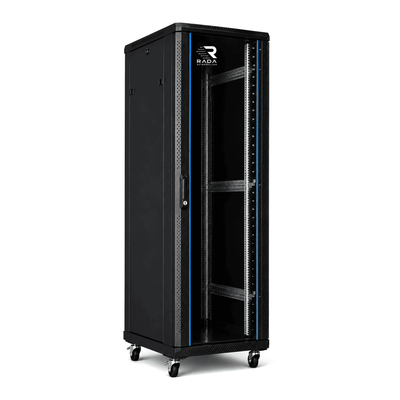
 Server cabinets
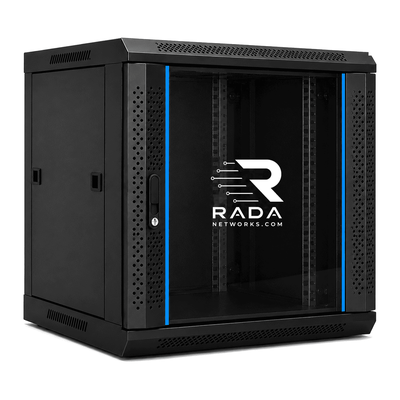 Wall-mount cabinets
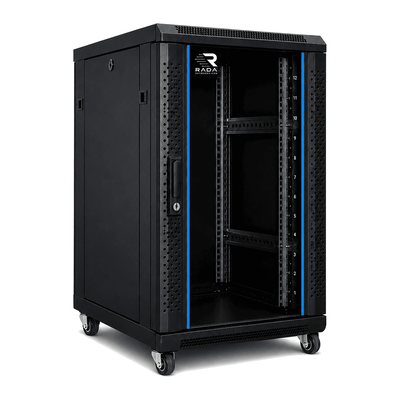 Compact server cabinets
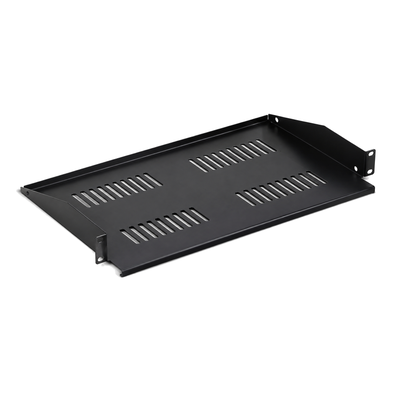 Accessories
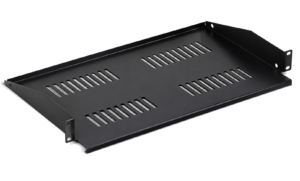
Knowledge centre
Practical guidance, worked examples and checklists for your 19-inch installation.
From dimensions to airflow.
Practical explanations, worked examples and checklists for choosing a cabinet that fits now and later.
A server cabinet is not an everyday purchase. This centre explains not just what rack units, usable depth and load capacity mean, but how to calculate and verify them. Start with an inventory of every device, then measure the cabinet, installation location and complete delivery route.
1. Server cabinet, patch cabinet or wall cabinet?
The name is only a starting point. A server cabinet is often deeper and has more perforated area for heat-producing equipment. A patch cabinet is generally intended for patch panels, switches and lighter network devices. Rack height, usable depth, load, airflow and mounting location are always decisive.
| Cabinet type | Often suitable for | Placement | Main point to check |
|---|---|---|---|
| Floor-standing server cabinet | Rack servers, larger UPS systems, active equipment and complete business networks | Level floor, generally on levelling feet | Depth, load, perforated doors, floor capacity and anchoring |
| Floor-standing patch cabinet | Patch panels, switches, routers, recorders and cable distribution | Technical room, office or patch area | Cable space, heat removal and front/rear access |
| Wall cabinet | Compact network with patch panel, switch, router or light equipment | Suitable load-bearing wall | Total depth and weight, wall construction and fixings |
| Mini or compact cabinet | Home network, small router/switch setup, NVR or compact installation | Wall, furniture or floor, depending on model | Mounting standard, ventilation, shelf and power supplies |
2. What do 19 inches and rack units mean?
“19 inch” describes the standard mounting width. The front plate of 19-inch equipment is 482.6 mm wide and attaches to the vertical mounting posts. Available height is expressed in U: 1U is 44.45 mm.
Record the U used by every device and include shelves, horizontal PDUs, cable managers and blanking panels. Equipment without 19-inch ears generally needs a shelf, plus enough clear height above it.
| Component | Common height | Check |
|---|---|---|
| Patch panel or switch | Often 1U | Ports and cables must remain accessible |
| Cable manager | Often 1U | Plan it next to panels and switches |
| Rack server | Often 1U–4U | Depth, weight and airflow |
| Rack UPS | Often 2U–4U | Heavy: install low and check rail or shelf support |
| Shelf with free-standing device | Shelf often 1U; device may need more | Measure plugs, antennas and ventilation clearance |
3. Measuring external and usable depth correctly
The external dimension is never fully usable. Doors, hinges, construction, ventilation and cabling occupy part of the space. Check the stated maximum usable mounting depth and the adjustment range of the front and rear posts.
- Measure the deepest device from the front mounting ears to the rearmost point of the chassis.
- Add protruding handles, plugs, SFPs, network cables and cable bend radius.
- Check whether four-post rails are required and fit within the post-spacing range.
- Retain service and airflow clearance so cables are not pressed against the rear door.
4. Load capacity, weight distribution and supporting surface
Total the weight of servers, UPS systems, switches, shelves, PDUs, cabling and future expansion. The stated load applies under manufacturer conditions and is generally a static, evenly distributed load. Permitted weight while moving on castors may be lower.
- Install UPS systems, batteries and heavy servers as low as possible.
- Distribute weight over suitable four-post rails or shelves and respect each component’s own rating.
- For a wall cabinet, verify the cabinet, wall type, fixing points and mounting hardware.
- For a heavy floor-standing setup, have the floor and any raised floor checked for point loads.
- Secure a tall or top-heavy cabinet against tipping, particularly with slide-out equipment.
5. Cooling and cable management
Identify which equipment produces heat and the direction in which its fans move air. Many servers and switches draw air at the front and exhaust at the rear. Cool air must reach the front and warm air must be able to leave at the rear or top.
- Doors: perforated doors suit high airflow. A glass door can work for a low heat load when intake and exhaust are sufficient.
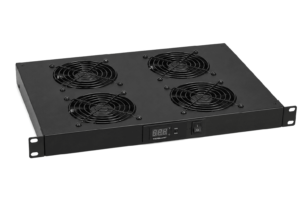
- Fans: a fan only helps when there is a free airflow path. Without an intake, extra fans may add noise without solving the problem.
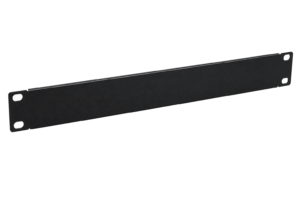
- Blanking panels: close unused U positions and can reduce hot-air recirculation.
- Cables: separate power and data where practical, respect bend radius and avoid bundles that are too tight to service.
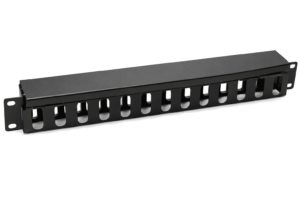
- Management: label both ends, use horizontal and vertical managers and retain a controlled service loop.
6. Placement, access and anchoring
Measure the final location and the whole route to it: doorways, corridors, lifts, turns, thresholds and changes in level. Compare them with the fully packed cabinet and check whether the pallet can be unloaded and moved.
7. Preparing for pallet delivery
Floor-standing cabinets are generally delivered assembled on a pallet. The carrier arranges the delivery time. Standard delivery is to the kerb or first accessible external ground-floor door; carrying inside, stair transport and placement are not included.
- Check lorry access and report restrictions in advance.
- Clear the unloading area and route and arrange enough people or suitable equipment for internal transport.
- Ensure someone is present to inspect and sign for the delivery.
- Before unpacking, check the number of packages and the packaging. Record visible damage on the delivery note and take photographs.
- Keep packaging and pallet until cabinet and accessories have been fully checked.
For rates, countries, accessibility and transport damage, read Shipping and delivery.
8. Power distribution, PDU and UPS
List the normal and maximum power consumption of all equipment. Then choose a PDU with suitable plugs, enough outlets and a current rating comfortably above the calculated load. Account for the available circuit, protection and any redundant power supplies.
- PDU: choose horizontal or vertical based on available U and cable route; check plug type, cable length and maximum current.
- UPS: check both watts and VA, required runtime, battery expansion, depth, weight and ventilation.
- Redundancy: dual-power equipment can be divided over separate PDUs or power paths where the infrastructure supports this.
- Safety: have fixed or modified electrical installations carried out and assessed by a qualified installer.
Read more: which UPS is needed for a server cabinet?
Visual summary
These summaries show why external depth differs from usable depth and how to combine rack units, weight and ventilation. Dimensions are examples; the selected product specification remains authoritative.
External and usable mounting depth
Combining height, weight and airflow
Quick checklist before ordering
| Check | Record |
|---|---|
| Equipment | Make/model, rackmount or free-standing, and required shelves |
| Height | Total rack units plus around 20–30% growth allowance |
| Depth | Deepest device with rails, plugs, cable bend and service margin |
| Weight | Equipment, UPS, shelves, PDUs, cables and expansion |
| Cooling | Heat sources, airflow direction, door type and fans |
| Power | Watts/VA, plug types, outlets, circuit and required runtime |
| Location and route | Floor or wall, service clearance, narrowest door/lift/turn and unloading |
| Future | Expected switches, servers, patch panels, cables and power outlets |
Frequently asked questions
Does a NAS fit in a 19-inch cabinet?
Yes, when it fits a suitable shelf and depth, weight, cable space and ventilation are correct. A desktop NAS is not automatically rack-mountable.
How many rack units should remain free?
Around 20–30% is a practical starting point. Also retain room in useful positions for cable management, airflow and service.
Glass or perforated door?
Glass suits visibility and a low heat load. With substantial active equipment, prioritise free air intake and a perforated design.
Are fans always required?
No. This depends on heat output, room temperature and the natural airflow path. Measure temperature first.
Is an 800 mm wide cabinet better?
Not necessarily. Extra width provides more room for vertical cable ducts and large bundles. A compact setup may fit in 600 mm.
Can a heavy UPS go in a wall cabinet?
Only when cabinet, shelf, wall and fixings demonstrably support the load. If uncertain, a floor-standing cabinet with the UPS low is safer.
Glossary
| Term | Meaning |
|---|---|
| U | A 44.45 mm height unit for rack equipment. |
| Usable mounting depth | Available distance for equipment; not the same as external cabinet depth. |
| PDU | Power Distribution Unit: distributes power within the cabinet. |
| UPS | Uninterruptible Power Supply: backup power and, depending on type, power conditioning. |
| Static load | Weight supported while stationary under the manufacturer’s conditions. |
| Four-post rail | Support attached to front and rear posts for deep or heavy equipment. |
Still uncertain about size or configuration?
Send the equipment list, dimensions, weights and installation location. We can help check height, depth, accessories and delivery requirements.
Further reading
- Which UPS is needed for a server cabinet?
- Installing a 22U cabinet step by step
- Choosing a 32U cabinet: load, security and expansion
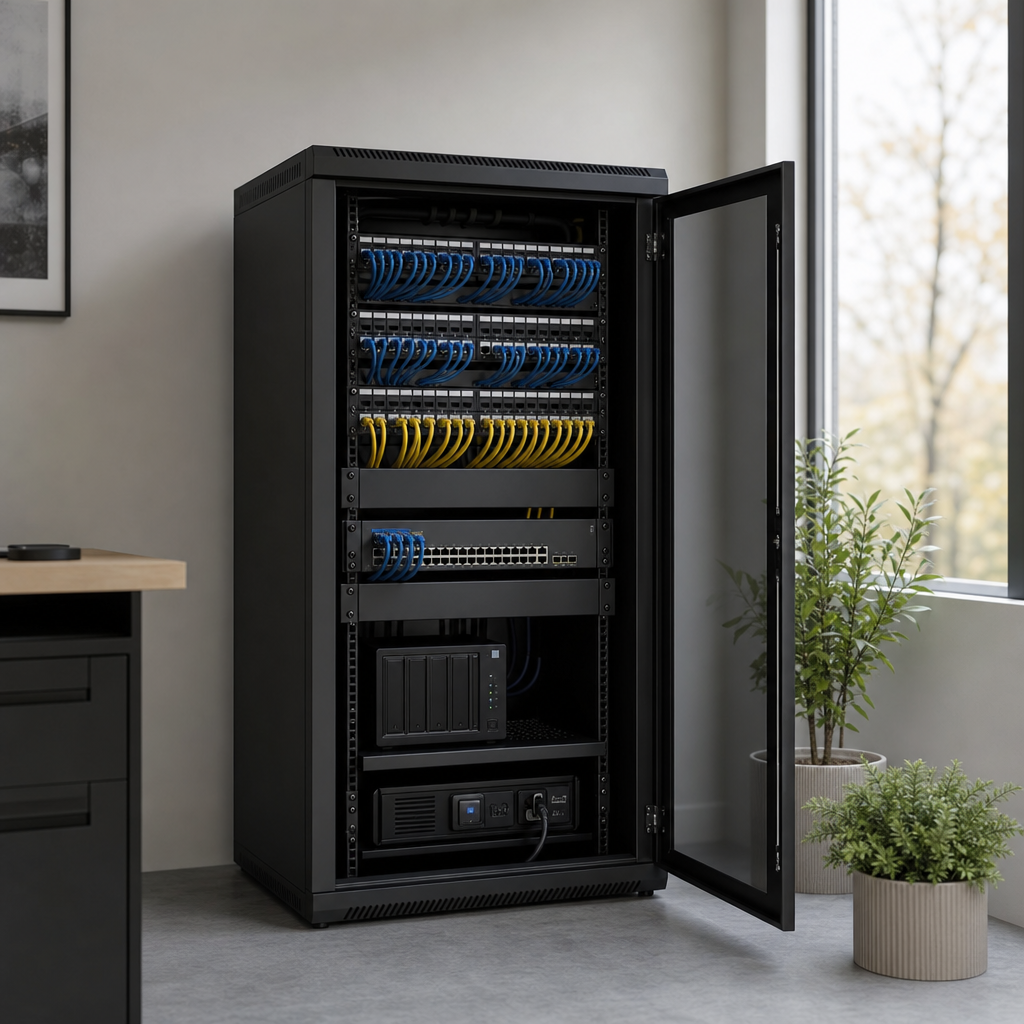
Choosing a 19-inch patch cabinet in Belgium: a measured planning guide
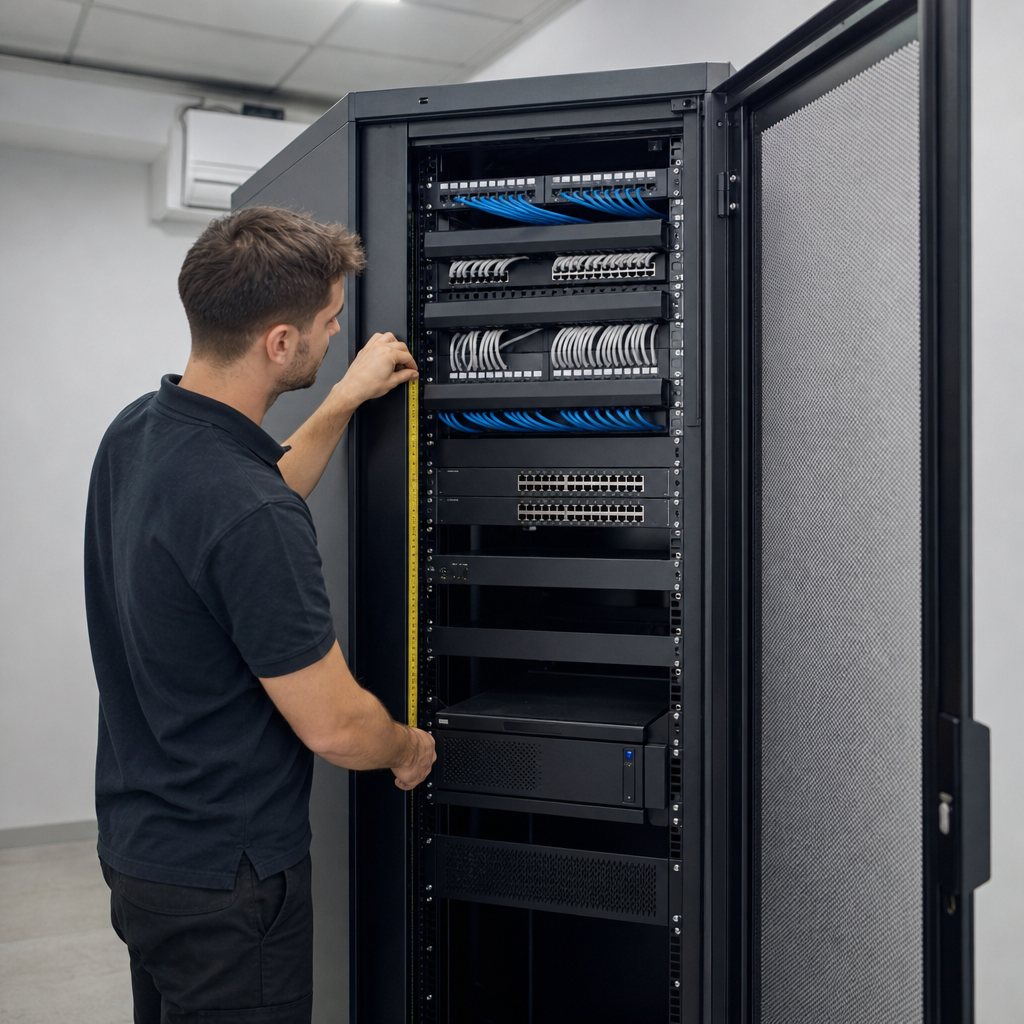
Calculate rack-unit height for a server cabinet in Belgium
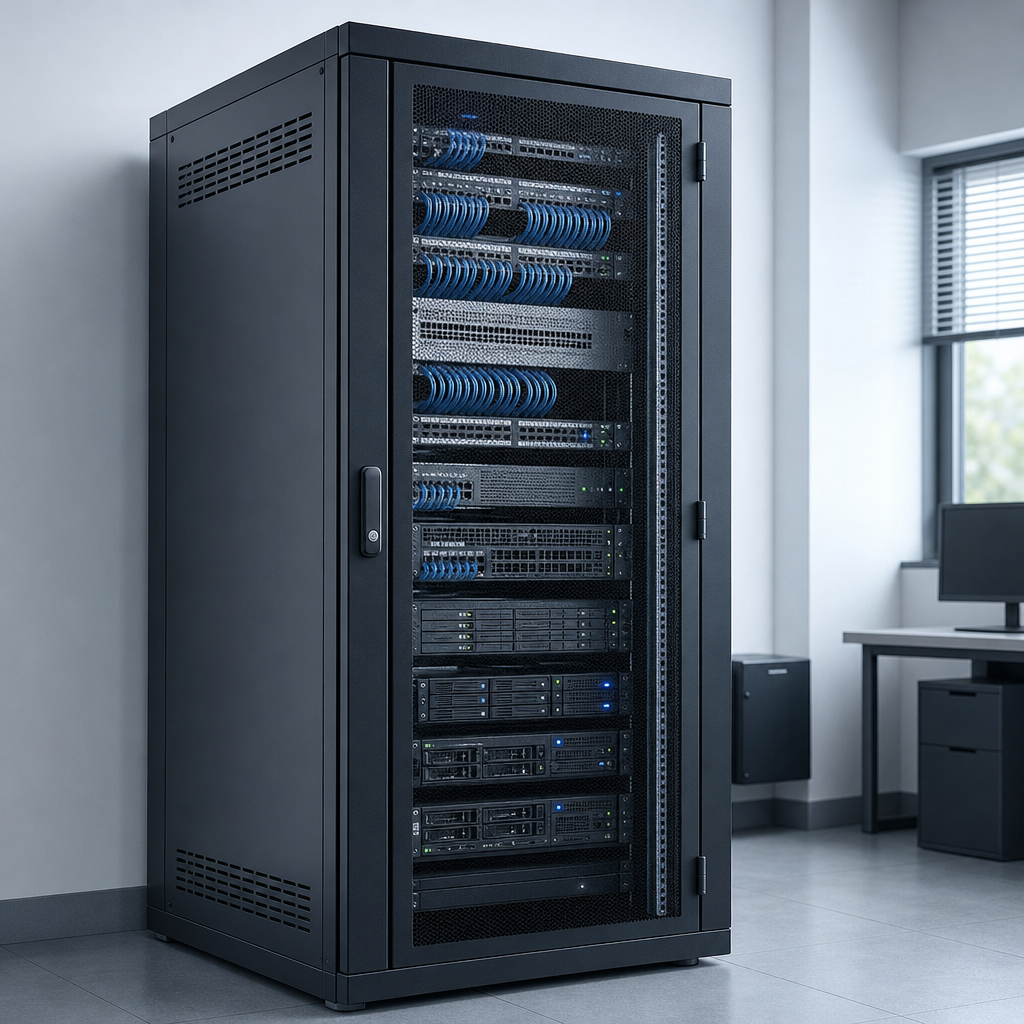
Choosing a 19-inch server cabinet: a Belgian buying check
A cabinet for your situation
UniFi
Measurements and layout for a UniFi installation.
Synology NAS
Shelf or RackStation, depth and ventilation.
Home network
Centralise the router, NAS, smart home and surveillance.
Office
Plan networking, storage, security and growth.
AI/GPU
Depth, load, power and cooling.
Browse categories
Complete the form below. Your request is sent directly to info@serverkastdirect.be.